validateConfiguration()
Use-case information
| Attribute | Value |
|---|---|
| Name | validateConfiguration() |
| Primary actor | Policy author |
| Goal | Establish that a configuration document composes and validates, and learn which accounts it declares |
| Level | User goal |
| Type | Primary, essential |
| Precondition | A configuration file exists and is readable |
| Successful postcondition | The document is proven to resolve; its accounts are known |
| Failure postcondition | Nothing is established; the first error is reported with its file and YAML path |
| Command | octoform config validate |
Specification diagram
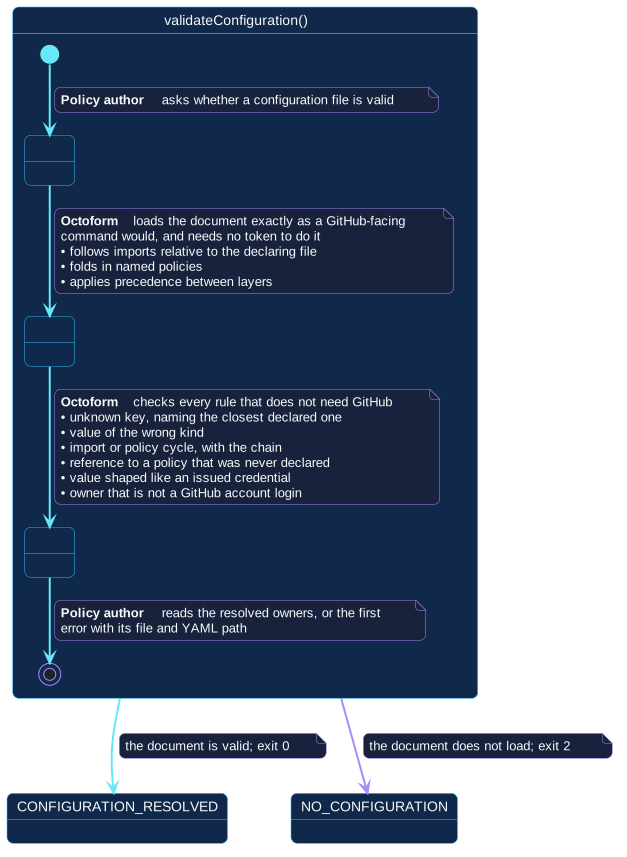
Detailed conversation
| Turn | Party | Exchange |
|---|---|---|
| 1 | Policy author | Asks whether a configuration file is valid |
| 2 | Octoform | Loads the document exactly as a GitHub-facing command would: follows imports relative to the declaring file, folds in named policies, applies precedence between layers |
| 3 | Octoform | Checks every rule that needs no GitHub state |
| 4 | Octoform | Reports the resolved accounts, or the first error with its file and YAML path |
| 5 | Policy author | Corrects the document, or proceeds knowing it resolves |
What turn 3 checks
Each of these is reported with its location rather than as a generic parse failure:
- an unknown key, named alongside the closest declared one;
- a value of the wrong kind;
- an import or policy cycle, with the chain that produced it;
- a reference to a policy that was never declared;
- a value shaped like an issued credential;
- a declared owner that is not a GitHub account login.
The last check does more work than it appears to. Every declared owner is
asked of the API by login, so a login carrying a path separator, a control
character, a leading or trailing hyphen, or a homoglyph that merely resembles
the intended account is caught here, with its reason, instead of surfacing as
an opaque 404 several requests into a later run.
Internal states
| State | Description | Responsibility |
|---|---|---|
RequestingCheck |
The author has asked, nothing has been read | Accept a path and nothing else |
Composing |
Imports and named policies are being folded in | Resolve exactly as a GitHub-facing command would, so the answer transfers |
Reporting |
The verdict is being presented | Name the file and the YAML path for any error, and never repeat a credential-shaped value |
Connection with the operator context
This use case implements the transition out of NO_CONFIGURATION:
NO_CONFIGURATION→validateConfiguration()→CONFIGURATION_RESOLVEDwhen the document loads, exiting0;NO_CONFIGURATION→validateConfiguration()→NO_CONFIGURATIONwhen it does not, exiting2.
The self-transition is the point of the use case. A document that fails to load leaves the author holding exactly what they held before.
Vocabulary
Policy author asks, corrects, proceeds. Octoform loads, composes, checks, reports. It never repairs a document and never guesses at an intended value.