planChanges()
Use-case information
| Attribute | Value |
|---|---|
| Name | planChanges() |
| Primary actor | Repository operator |
| Goal | Learn what would change, for an explicit policy and a deliberately narrow selection |
| Level | User goal |
| Type | Primary, essential |
| Precondition | A configuration resolves; a token is available |
| Successful postcondition | Every candidate is sorted into exactly one category and presented; GitHub is unchanged |
| Failure postcondition | Discovery or observation failed; the run reports it and applies nothing |
| Command | octoform plan |
Specification diagram
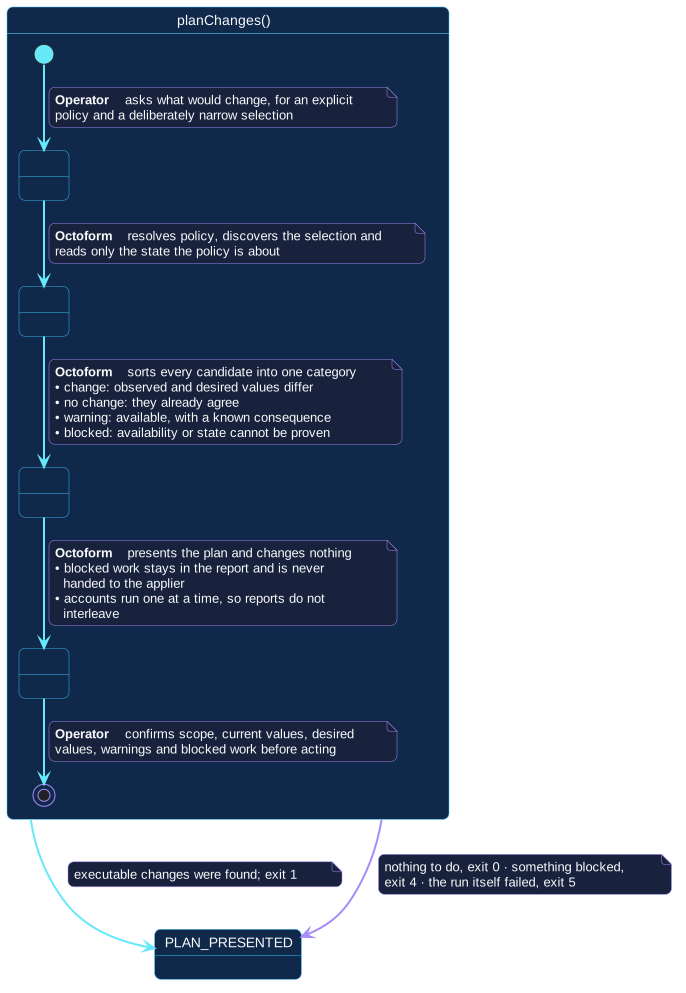
Detailed conversation
| Turn | Party | Exchange |
|---|---|---|
| 1 | Repository operator | Asks what would change, for an explicit policy and a narrow selection |
| 2 | Octoform | Resolves policy, discovers the selection, and reads only the state the policy is about |
| 3 | Octoform | Sorts every candidate into one of four categories |
| 4 | Octoform | Presents the plan and changes nothing |
| 5 | Repository operator | Confirms scope, current values, desired values, warnings, and blocked work before acting |
The four categories
| Category | Meaning | What the operator does |
|---|---|---|
| Change | Observed and desired values differ | Confirm repository, field, current value, and desired value |
| No change | They already agree | Nothing |
| Warning | The change is available but has a known consequence | Resolve or explicitly accept the consequence |
| Blocked | Availability or current state cannot be proven | Correct access, applicability, or policy, then plan again |
Blocked work stays in the report. It is never removed, never counted as convergence, and never handed to the applier.
Available since 0.4.1
The per-account counts are exclusive so they sum to the number scanned,
which files a repository that is both changed and blocked under changed.
The number of repositories carrying blocked work is therefore stated
alongside the totals, so the summary cannot understate what the plan
cannot apply. See reading the summary.
Reading order across accounts
When a configuration declares several accounts, they run one at a time in
declaration order, so their reports never interleave. A failure in one does not
stop the rest by default; --fail-fast stops at the first. The run's exit
class is the most severe any account produced.
Internal states
| State | Description | Responsibility |
|---|---|---|
RequestingPlan |
The operator has asked, nothing has been read | Establish policy and selection before spending a request |
Observing |
GitHub state is being read | Read only the state the policy is about |
Classifying |
Candidates are being sorted | Put every candidate in exactly one category, and never leave one uncategorised |
Presenting |
The plan is being shown | Show blocked work as part of the plan, not as an aside |
Connection with the operator context
CONFIGURATION_RESOLVED→planChanges()→PLAN_PRESENTED
The exit class distinguishes what was found: 0 when nothing needs doing, 1
when executable changes were found, 4 when something was blocked, 5 when
the run itself failed.
Vocabulary
Repository operator asks, confirms, narrows. Octoform resolves, observes, classifies, presents. It never attempts and never silently drops a candidate it could not categorise.
References
octoform plansavePlan()for the reviewable artifactapplyPlan(), which includes this use case