classifyRepositories()
Use-case information
| Attribute | Value |
|---|---|
| Name | classifyRepositories() |
| Primary actor | Repository operator |
| Goal | Learn which type each unclassified repository should carry, and optionally persist it |
| Level | User goal |
| Type | Primary, essential |
| Precondition | A configuration resolves and declares classification rules; a token is available |
| Successful postcondition | A proposal is reported; with --apply, accepted values are written as an organization custom property |
| Failure postcondition | Nothing is written; the reason is reported |
| Command | octoform classify |
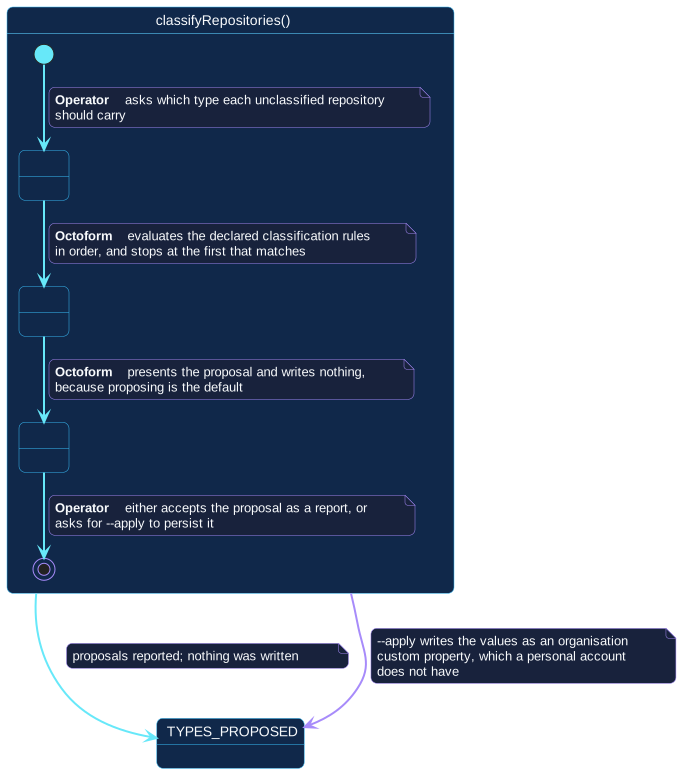
Specification diagram
Detailed conversation
| Turn | Party | Exchange |
|---|---|---|
| 1 | Repository operator | Asks which type each unclassified repository should carry |
| 2 | Octoform | Evaluates the declared classification rules in order and stops at the first that matches |
| 3 | Octoform | Presents the proposal and writes nothing, because proposing is the default |
| 4 | Repository operator | Accepts the proposal as a report, or asks for --apply to persist it |
Order is part of the requirement
Rules are evaluated in declaration order and the first match wins. That makes the order of the rules a decision the author is making, whether or not they intend to: moving a broad rule above a narrow one silently changes what the narrow one classifies. The proposal is reported before anything is written precisely so that this is visible.
The alternate flow is account-shaped
--apply writes the value as an organization custom property. A personal
account does not have organization custom properties, so this alternate flow
does not exist there. That is reported as an inapplicable declaration by
inspectCapabilities() rather than discovered as a
failure mid-run.
A personal account can still be classified from local evidence and still use repository rulesets; only the persistence step is unavailable.
Internal states
| State | Description | Responsibility |
|---|---|---|
RequestingProposal |
The operator has asked for types | Establish the selection |
Evaluating |
Rules are being applied in order | Stop at the first match, and make the winning rule attributable |
Proposing |
The proposal is being presented | Write nothing unless persistence was explicitly requested |
Connection with the operator context
CONFIGURATION_RESOLVED→classifyRepositories()→TYPES_PROPOSEDTYPES_PROPOSED→classifyRepositories()→TYPES_PROPOSED
The self-transition is meaningful: re-running the proposal is safe because proposing writes nothing.
Vocabulary
Repository operator asks, accepts, persists. Octoform evaluates, proposes, writes only when asked. It never infers that a proposal should be persisted because it was produced.