savePlan()
Use-case information
| Attribute | Value |
|---|---|
| Name | savePlan() |
| Primary actor | Change reviewer |
| Goal | Turn a reviewed plan into an artifact that someone else, or something else, can carry out unchanged |
| Level | User goal |
| Type | Primary, essential to the 0.4 release |
| Precondition | A plan can be produced for the selection |
| Successful postcondition | An artifact exists on disk recording the operations and the identity they were produced under |
| Failure postcondition | No artifact is written |
| Command | octoform plan --out <path> |
Specification diagram
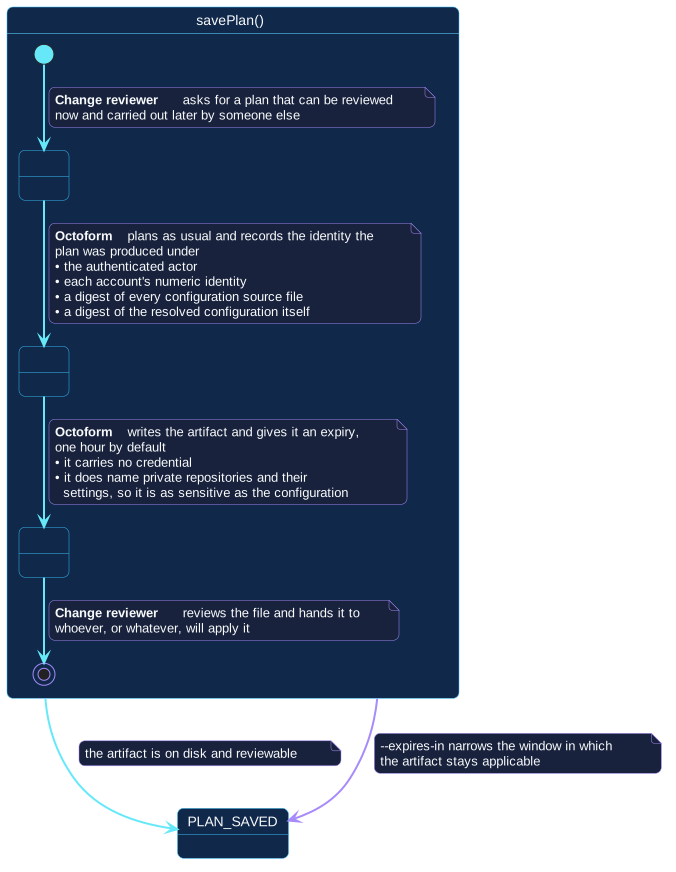
Detailed conversation
| Turn | Party | Exchange |
|---|---|---|
| 1 | Change reviewer | Asks for a plan that can be reviewed now and carried out later |
| 2 | Octoform | Plans as usual, then records the identity the plan was produced under |
| 3 | Octoform | Writes the artifact and gives it an expiry, one hour by default |
| 4 | Change reviewer | Reviews the file and hands it to whoever, or whatever, will apply it |
What the artifact records
Four things, each of which applySavedPlan() will
re-check before acting:
- the authenticated actor the plan was produced as;
- each account's numeric identity, which is stable across renames;
- a digest of every configuration source file that contributed;
- a digest of the resolved configuration itself, computed over a canonical form so that reordering keys is not treated as a change.
Recording both digests is deliberate. The source digest catches an edited file; the structural digest catches a document that was rewritten to look different while meaning the same, or the reverse.
Why the problem is worth an artifact
Planning and applying separately means two observations and two plans, and nothing forces them to agree. The gap between them is where an unreviewed change gets in. The artifact closes it by making the second command refuse anything the first did not describe.
Handling
The artifact carries no credential. It does name private repositories and their settings, so it deserves the same care as the configuration: it is not a build log attachment.
The expiry exists because a plan describes an observation, and observations
go stale. --expires-in <minutes> narrows the window.
Internal states
| State | Description | Responsibility |
|---|---|---|
RequestingArtifact |
The reviewer has asked for a durable plan | Accept a destination and an optional expiry |
Recording |
Identity is being captured alongside the operations | Record enough to detect a moved world later, and no credential |
HandingOver |
The artifact has been written | Make the file reviewable on its own |
Connection with the operator context
CONFIGURATION_RESOLVED→savePlan()→PLAN_SAVED
PLAN_SAVED is one of only two states in the context from which work can
continue in a later invocation, and it is the only one that survives the
process exiting.
Vocabulary
Change reviewer asks, reviews, hands over. Octoform plans, records, writes. It does not sign the artifact and does not claim the artifact proves who reviewed it.