inviteMember()
Use-case information
| Attribute | Value |
|---|---|
| Name | inviteMember() |
| Primary actor | Repository operator |
| Goal | Invite one named person to the organization |
| Level | User goal |
| Type | Secondary |
| Precondition | The selected account is an organization; the token can administer its membership |
| Successful postcondition | Exactly one invitation was sent, or the person was already a member or already invited |
| Failure postcondition | Nothing was sent, and the reason names the login, the role, or GitHub's refusal |
| Command | octoform members invite --user <login> [--role <role>] |
Specification diagram
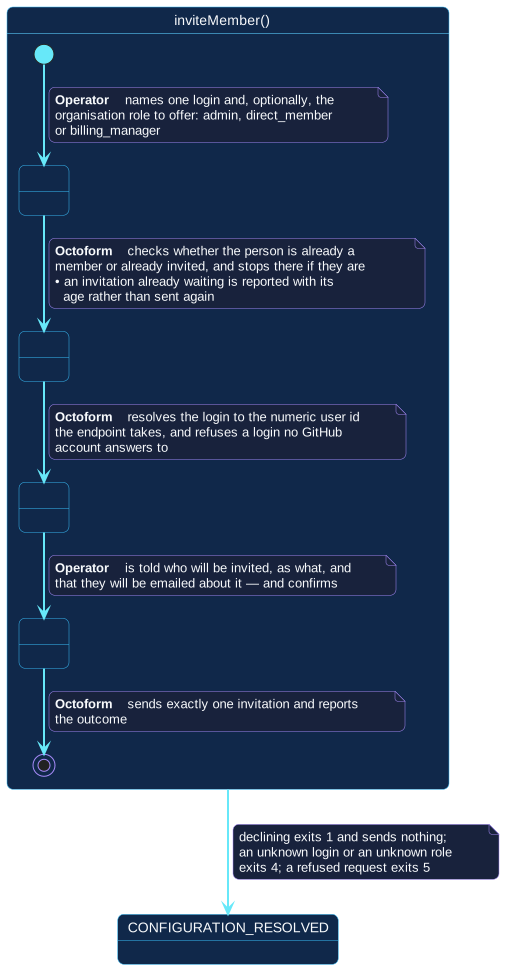
Detailed conversation
| Turn | Party | Exchange |
|---|---|---|
| 1 | Repository operator | Names one login, and optionally the organization role to offer |
| 2 | Octoform | Reports and stops when the person is already a member, or when an invitation to them is already waiting |
| 3 | Octoform | Resolves the login to the user id the endpoint takes, and refuses a login no account answers to |
| 4 | Octoform | States who will be invited, as what, and that they will be emailed about it |
| 5 | Repository operator | Confirms |
| 6 | Octoform | Sends exactly one invitation and reports the outcome |
Why this is a command and not a policy
An invitation is an act addressed to a person, who is then emailed about it. A file that listed members authoritatively would remove somebody the first time a name was mistyped, and would send an invitation because a schedule fired rather than because anybody decided to.
GitHub's own note on the endpoint — that inviting people too quickly runs into secondary rate limiting — is the API agreeing that this is not a bulk reconciliation operation.
The login is resolved first
The invitation endpoint takes a numeric user id or an email address. It does not take a login. So the login has to be resolved, and refusing one that resolves to nothing costs one request and prevents inviting a stranger by a name nobody checked.
Idempotence without a plan
There is no diff here, so the two "already done" states carry it instead:
- Already a member: reported, exit
0, nothing sent. - Already invited: reported with how long they have been waiting, exit
0, nothing sent. A second invitation is not what a stale one needs.
Internal states
| State | Description | Responsibility |
|---|---|---|
NamingOnePerson |
One login and one role have been supplied | Reject a role that is not one of the three GitHub accepts |
Resolving |
The organization's people and the login are being checked | Stop, successfully, when there is nothing to send |
Asking |
The consequence has been stated | Say that the person will be emailed, before asking |
Sending |
The invitation is being sent | Send one, and report what GitHub said |
Connection with the operator context
CONFIGURATION_RESOLVED→inviteMember()→MEMBERSHIP_CHANGEDCONFIGURATION_RESOLVED→inviteMember()→CONFIGURATION_RESOLVEDwhen the confirmation is declined, the login or role is refused, or GitHub refuses the request
Vocabulary
Repository operator names, confirms. Octoform checks, resolves, states, asks, sends, reports. It never invites more than one person, and never without asking.