applyPlan()
Use-case information
| Attribute | Value |
|---|---|
| Name | applyPlan() |
| Primary actor | Repository operator |
| Goal | Converge a selection the operator has already planned and understood |
| Level | User goal |
| Type | Primary, essential |
| Precondition | A configuration resolves; a token with sufficient permission is available |
| Successful postcondition | Every executable operation was attempted and its outcome reported |
| Failure postcondition | Declined, blocked, or failed; what succeeded is not rolled back |
| Command | octoform apply |
Specification diagram
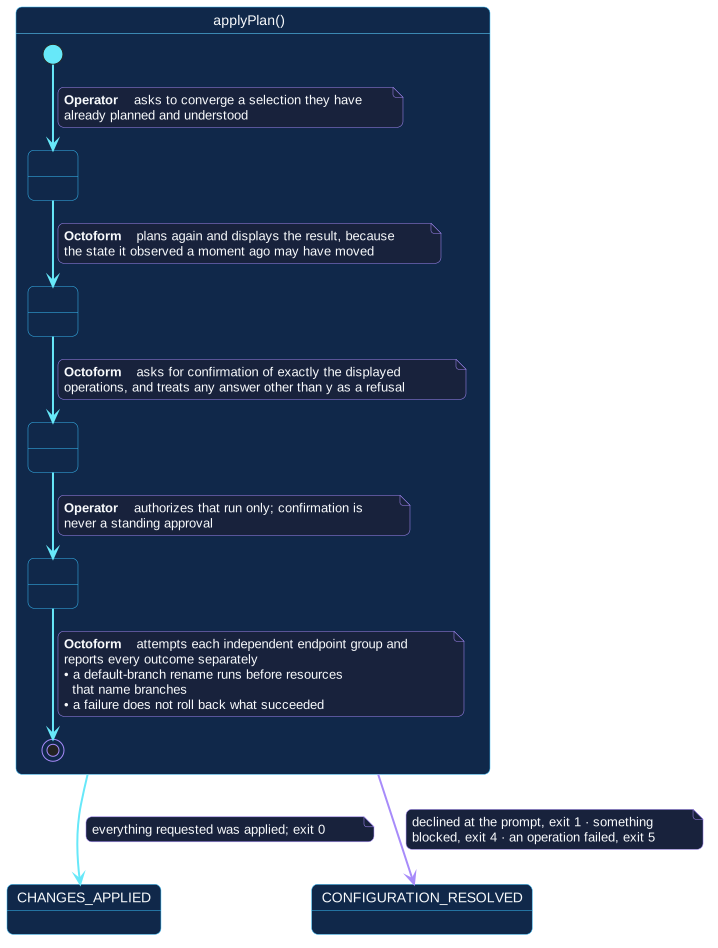
Detailed conversation
| Turn | Party | Exchange |
|---|---|---|
| 1 | Repository operator | Asks to converge a selection they have already planned |
| 2 | Octoform | Plans again and displays the result, because the state observed a moment ago may have moved |
| 3 | Octoform | Asks for confirmation of exactly the displayed operations |
| 4 | Repository operator | Authorizes that run, or declines |
| 5 | Octoform | Attempts each independent endpoint group and reports every outcome separately |
Confirmation is scoped to the run
Answering y authorizes the operations that were just displayed, for that
invocation. It is not a standing approval, and it does not carry to the next
run. Any answer other than y declines and exits without mutation.
--yes replaces the prompt, not the review. It belongs only in a path where
configuration review, plan retention, credential scope, and environment
approval already do the work the prompt was doing.
Ordering and partial failure
Octoform groups settings that share a GitHub endpoint, so those settings succeed or fail together in one request. A default-branch rename runs before resources that name branches, so rulesets and created files target the declared branch name.
Independent groups are attempted even when another group fails. A failure therefore does not imply that everything was rolled back — there is no rollback. Recovery is to plan again, observe the resulting state, and decide from there.
Internal states
| State | Description | Responsibility |
|---|---|---|
RequestingApply |
The operator has asked to converge | Establish policy and selection |
Presenting |
A fresh plan is being displayed | Show what will be attempted now, not what was planned earlier |
Confirming |
Authorization is being requested | Treat anything but y as a refusal |
Executing |
Operations are being attempted | Report each outcome separately, and never claim an unattempted operation succeeded |
Connection with the operator context
PLAN_PRESENTED→applyPlan()→CHANGES_APPLIEDPLAN_PRESENTED→applyPlan()→CONFIGURATION_RESOLVEDwhen declined
This transition happens inside a single invocation: applyPlan() includes
planChanges(), which is why PLAN_PRESENTED is reached first. Exit 1 when
declined, 4 when something was blocked, 5 when an operation failed.
Vocabulary
Repository operator asks, authorizes, declines. Octoform plans, displays, asks, attempts, reports. It never applies anything it did not display, and never retries on the operator's behalf.
References
octoform applyplanChanges(), which this use case includes- Operate plan and apply safely