Operator context
This is the model every use case is placed on. Each state is something the operator holds; each transition is a use case with its own specification.
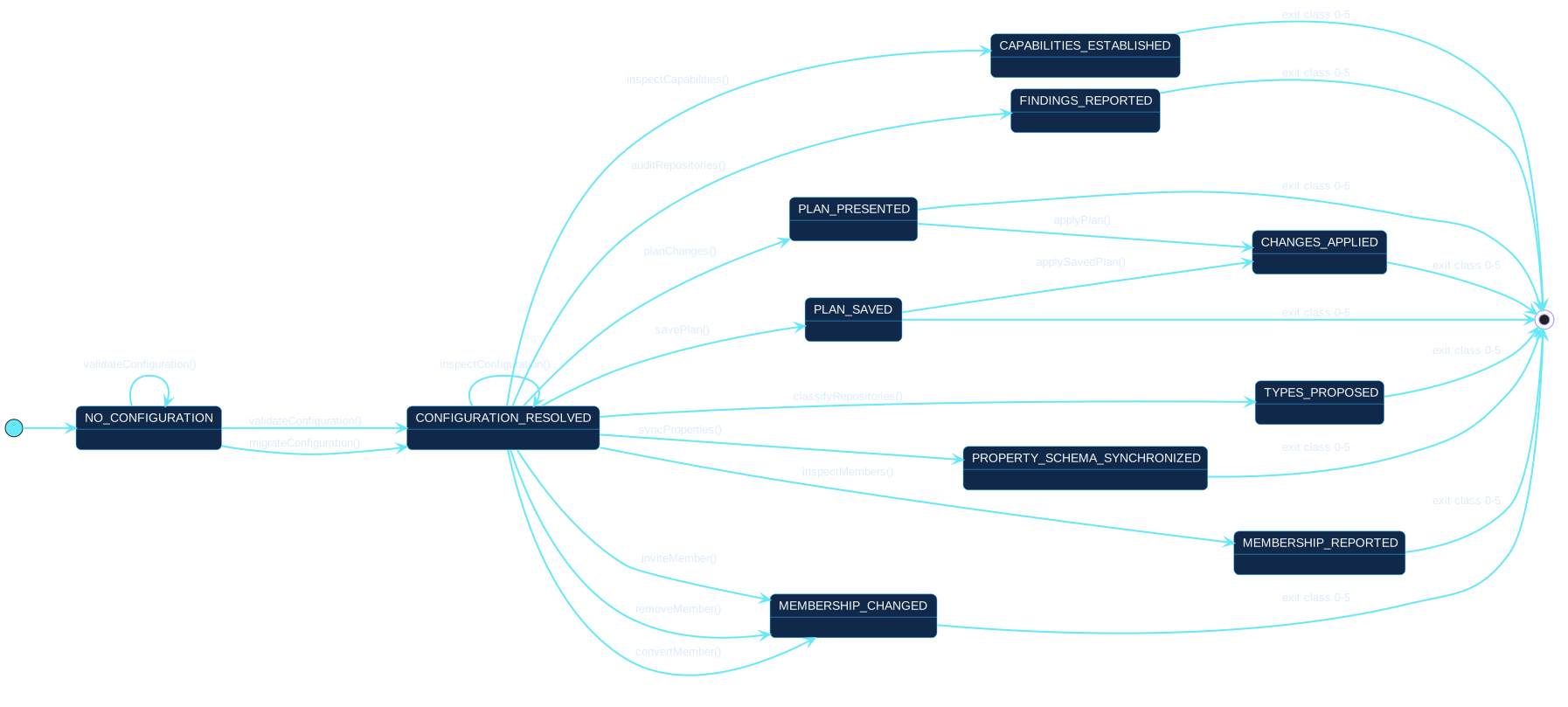
States are held, not displayed
Octoform has no screens, so a state here is not a view. It is what the operator has established and can act on.
| State | What the operator holds |
|---|---|
NO_CONFIGURATION |
Nothing has been resolved. A file may exist, but it has not been proven to load. |
CONFIGURATION_RESOLVED |
A document that composes, validates, and names its accounts. No GitHub state has been read. |
CAPABILITIES_ESTABLISHED |
Evidence of what each selected account is and supports. |
FINDINGS_REPORTED |
Audit findings against observed metadata, with no desired state declared for them. |
PLAN_PRESENTED |
A plan on screen, valid for the observation that produced it. |
PLAN_SAVED |
A plan as a file, carrying the identity it was produced under. |
CHANGES_APPLIED |
Per-operation outcomes. Not a guarantee that every operation succeeded. |
TYPES_PROPOSED |
Proposed repository types, written only when --apply was requested. |
PROPERTY_SCHEMA_SYNCHRONIZED |
An organization property schema converged with the declared types. |
MEMBERSHIP_REPORTED |
Who is in the organization, and which of the people the configuration names are not. |
MEMBERSHIP_CHANGED |
One person invited, removed, or converted. Never more than one. |
Why most states are terminal
Almost every state leads to the final state rather than back to
CONFIGURATION_RESOLVED. That is the honest shape for a command-line tool:
the process exits, and nothing is retained between invocations except what was
written to disk.
Two transitions therefore matter more than the rest, because they are the only ones that carry work forward:
planChanges()toapplyPlan()happens inside one invocation.applyplans again and shows the result before asking, because the state observed a moment earlier may have moved.savePlan()toapplySavedPlan()happens across invocations, and it is possible only because the plan was persisted. This is the separation of duties introduced in 0.4: the reviewer and the applier need not be the same person or process.
Every other apparent continuation — planning, then applying tomorrow from memory — is not modelled because Octoform does not support it. A plan that was not saved cannot be applied later.
MEMBERSHIP_CHANGED is deliberately outside the plan
Three transitions reach it, and none of them goes through PLAN_PRESENTED.
That is the one place in this model where a write is not preceded by a plan,
and it is a design decision rather than an omission: an invitation is an act
addressed to a person who is emailed about it, so it is confirmed one login at
a time rather than reconciled by a schedule. See
octoform members.
Everything the organization itself holds — its profile, its member policies,
its properties, rulesets, teams and roles — does go through
PLAN_PRESENTED, because a setting that reaches every repository an account
owns should never be the one thing nobody saw a diff for.
Self-transitions are not idle
Three transitions return to the state they left, and each says something.
NO_CONFIGURATIONto itself onvalidateConfiguration(): the document did not load. The operator holds no more than before, and the command exits2.CONFIGURATION_RESOLVEDto itself oninspectConfiguration(): the resolved shape is printed and nothing is established beyond it.TYPES_PROPOSEDto itself onclassifyRepositories(): re-running the proposal is safe, because proposing writes nothing.
Traceability
Use this model as the index. Follow a transition to its specification for the conversation inside it, and follow a specification's outgoing arrows back to the state they land on here.
The transition to the final state is labelled with the exit class rather than
a use case, because ending is not a goal an actor pursues. The classes are
frozen for the whole v0 line and are listed in the
execution contract.